
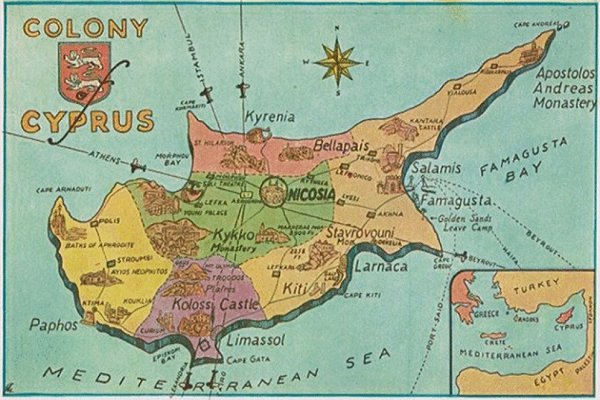
Cyprus, with its rich and complex history, has been at the crossroads of civilizations for millennia. Its history is marked by a series of foreign invasions, cultural influences, and struggles for independence. Here’s a concise overview of Cyprus’ history, focusing on key periods and events.
1. Ancient Cyprus (c. 10,000 BCE – 4th century BCE)
Prehistoric and Early Civilizations (10,000 BCE – 1500 BCE)
- First settlers: Evidence of human settlement on Cyprus dates back to around 10,000 BCE (Epipalaeolithic period). Early settlers engaged in hunting, fishing, and gathering, eventually developing agriculture.
- Copper Age: Cyprus is often called the “Island of Copper” because of the significant copper deposits, which were mined as early as the 3rd millennium BCE. The island was an important center for metallurgy.
Classical Period (1500 BCE – 4th century BCE)
- Mycenaean influence: Around 1500 BCE, Mycenaean Greeks settled on the island, bringing Greek culture, language, and religion. This period laid the foundation for the Hellenistic culture that would later dominate the island.
- Phoenician settlement: By the 9th century BCE, the Phoenicians established trading centers, particularly in Kition (modern Larnaca). The Phoenicians introduced their writing system and became important in the island’s maritime trade.
- Greek city-kingdoms: During this period, Cyprus was divided into several independent Greek city-kingdoms like Salamis, Paphos, and Kourion. These cities maintained close connections with other Greek states, including Athens.
2. Roman and Byzantine Rule (1st century BCE – 12th century CE)
Roman Period (58 BCE – 395 CE)
- Roman conquest: Cyprus became a Roman province in 58 BCE after its annexation by the Roman Republic, initially as part of the Roman Empire’s expansion.
- Christianity: During the Roman period, Christianity spread to Cyprus, with the Apostle Paul and Barnabas (who was born on the island) preaching the Christian faith. Barnabas is traditionally considered the first bishop of Cyprus.
- Byzantine Period (330 CE – 1191 CE): After the division of the Roman Empire, Cyprus became part of the Byzantine Empire. Christianity flourished, and the Orthodox Church of Cyprus was established. During this period, the island saw several attacks by Arabs and the rise of monasticism, with famous monasteries like Kykkos Monastery founded.
3. Medieval Cyprus (12th – 15th century)
Crusader Period (1191 – 1489)
- Richard the Lionheart: In 1191, Richard the Lionheart of England captured Cyprus during the Third Crusade. He sold the island to the Knights Templar, but it was soon taken over by the Lusignan dynasty in 1192, a French noble family.
- Lusignan Kingdom: The Lusignans established the Kingdom of Cyprus and made it a powerful feudal state. The period was marked by constant tension between the Catholic Church and the Orthodox Christian population.
- Venetian Rule: In 1489, Cyprus was handed over to the Venetians by the last Lusignan queen, Catherine Cornaro, due to political pressures. The Venetians sought to control Cyprus for its strategic location, especially as the Ottoman Empire grew in power.
4. Ottoman Rule (1571 – 1878)
- Ottoman Conquest: In 1571, after a naval battle, the Ottoman Empire captured Cyprus from the Venetians. The Ottomans ruled the island for over 300 years, and during this period, the majority of the population converted to Islam while Greek Orthodox Christians continued to be the dominant community.
- Ottoman Administration: The Ottomans introduced land reforms, and many Cypriots were granted land under the millet system, which allowed religious communities to govern themselves. However, the Christian Greeks were often subject to heavy taxation and oppression.
- Tensions: The Ottoman period was also marked by periods of rebellion from the Greek Christian population and disputes with the Muslim community, but Cyprus remained under Ottoman control.
5. British Colonial Period (1878 – 1960)
- British Rule: In 1878, following the Cyprus Convention, the Ottoman Empire leased Cyprus to the British Empire for strategic reasons, especially to control the eastern Mediterranean. In 1914, when the Ottoman Empire entered World War I on the side of the Central Powers, Britain formally annexed Cyprus.
- Cypriot Nationalism: Throughout British rule, there was growing nationalist sentiment among the Greek Cypriot population, largely driven by the desire for Enosis (union with Greece). This was opposed by the Turkish Cypriots, who sought to remain under British rule or join Turkey.
- World War II: During World War II, Cyprus was a key British base in the Mediterranean. After the war, tensions between the Greek Cypriot and Turkish Cypriot communities increased, with sporadic violence.
- EOKA: The EOKA (National Organization of Cypriot Fighters) was formed in 1955 under the leadership of Georgios Grivas, aiming for Enosis. A bloody insurgency against British rule followed.
6. Independence and Division (1960 – Present)
Independence and Inter-communal Tensions (1960 – 1974)
- Independence: In 1960, Cyprus gained independence from Britain, and the Republic of Cyprus was founded under a power-sharing agreement between Greek Cypriots and Turkish Cypriots. Archbishop Makarios III became the first president.
- Inter-communal Violence: The 1960s were marked by increasing tensions between the Greek Cypriots and Turkish Cypriots, resulting in violent clashes. The United Nations Peacekeeping Force in Cyprus (UNFICYP) was deployed in 1964 to maintain peace.
- Military Coup: In 1974, a Greek-backed military coup in Cyprus overthrew President Makarios, aiming for Enosis with Greece. This led to a Turkish invasion of Cyprus.
Turkish Invasion and Division (1974)
- Turkish Invasion: In response to the coup, Turkey launched a military invasion in July 1974, occupying the northern part of the island. The invasion led to the establishment of a Turkish Republic of Northern Cyprus (TRNC), which is only recognized by Turkey.
- Division: The island remains divided into two parts: the internationally recognized Republic of Cyprus in the south (Greek Cypriot-controlled) and the Turkish Republic of Northern Cyprus in the north (Turkish Cypriot-controlled). The UN-patrolled Green Line separates the two areas.
Recent Developments
- Peace Talks: Over the years, various efforts, including UN-led peace talks, have aimed to reunify the island, but a final resolution has not been reached.
- EU Membership: In 2004, Cyprus joined the European Union as a whole, but the Turkish-controlled north is not part of the EU legal framework.
- Continued Division: The situation remains politically complex, with occasional negotiations and tensions over issues like the status of Turkish settlers, property claims, and the presence of Turkish troops in the north.

